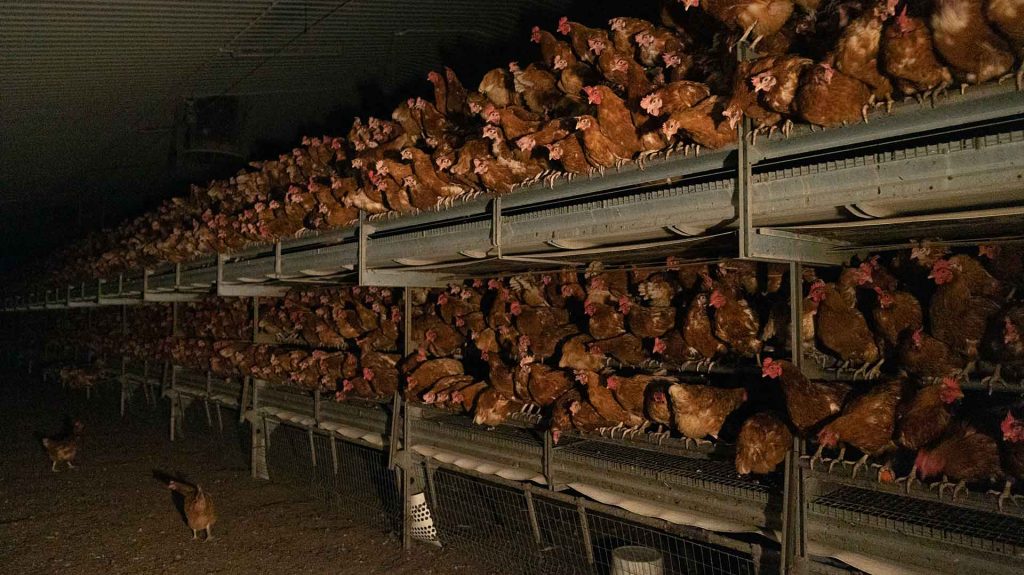
Photo credit: Rebecca Cappelli Loviconi / We Animals
Let’s talk about how factory farming hurts humans and animals alike.
Human Health: Livestock product commands around 80% of the total land that humans use to produce food, while providing only 18% of global calories and 38% of protein. In a world where 28% of people suffer from food insecurity, our land, water, and energy should be used more efficiently. Additionally, much of the meat that is produces has unhealthy levels of fat and bacterial contamination which contributes to obesity and other health issues.
Farm Animals: It goes without saying that the billions of animals who are forcefully bred and killed each year globally suffer unbelievably within factory farms. They are confined to tiny cages often never feeling fresh air or touching the ground. Every part of their life is suffering until they are brutally killed.
Wild Animals: Factory Farming contributes 14.5%–29.7% of global human-induced greenhouse gas emissions which is a huge part of global warming and the loss of habitats for wild animals. Furthermore, habitats are destroyed directly to make space for the crops to feed the animals confined within factory farms.
Plants and Ecosystems: Factory farming is a huge contributor to destruction of the environment. We have forest fires from global warming, clearing forests for agriculture, and the impact of runoff from pesticides affecting insects, birds, and water.
Infectious disease risk: Experts estimate that approximately 75% of emerging infectious diseases in humans originate in animals. The conditions in factory farms are ideal for the spread and mutation of infectious diseases which can, and often do, jump species and infect humans. Factory farms are also breeding grounds for antibiotic resistance, because of the overuse and generalized use of them. This can create “superviruses” which would spell disaster for humans. All intensive farming carries an outsized risk of emerging diseases. Scientific experts recognize that the industrial production of animals is a major risk factor in the next pandemic.
The above information is only a brief overview of the issues at hand. If you would like to read more, see the cited sources below for more detail.
“We know, at least, that this decision (ending factory farming) will help prevent deforestation, curb global warming, reduce pollution, save oil reserves, lessen the burden on rural America, decrease human rights abuses, improve publish health, and help eliminate the most systematic animal abuse in history.” ― Jonathan Safran Foer, Eating Animals
Sources:
World Animal Protection: The hidden health impacts of factory farming , The hidden health impacts of industrial livestock systems
World Health Organization: Stop using antibiotics in healthy animals to prevent the spread of antibiotic resistance
Our World in Data: How many animals are factory-farmed? – Our World in Data PMC: What’s Wrong With Factory Farming? – PMC , Farm-grown superbugs: While the world acts, Canada dawdles – PMC
 Français du Canada